
Creative Biolabs is offering the most comprehensive services for antibody development projects. With strict regulation and effective execution, we are dedicated to providing the most valuable solutions to complete your projects.
HighlightsCreative Biolabs is offering the most comprehensive services for antibody development projects. With strict regulation and effective execution, we are dedicated to providing the most valuable solutions to complete your projects.
HighlightsCreative Biolabs has established a broad range of platforms for developing novel antibodies or equivalents. These cutting-edge technologies enable our scientists to meet your demands from different aspects and tailor the most appropriate solution that contributes to the success of your projects.
HighlightsWith deep understanding in antibody-related realms and extensive project experience, Creative Biolabs offers a variety of references to help you learn more about our capacities and achievements, including infographic, flyer, case study, peer-reviewed publications, and all kinds of knowledge that can assist your projects. You are also welcome to contact us directly for more specific solutions.
HighlightsGet a real taste of Creative Biolabs, one of the most professional custom service providers in the world. We are committed to providing highly customized comprehensive solutions with the best quality to advance your projects.
HighlightsAt the forefront of therapeutic antibody development, minimizing immunogenicity while preserving high affinity is the ultimate goal. Today, Creative Biolabs are proud to offer our state-of-the-art Humanized Antibody Germinalization Service, a critical step in creating safer and more effective antibody-based therapeutics. The journey from a promising non-human antibody to a clinical candidate is fraught with challenges. Standard humanization techniques, while effective at reducing the foreignness of an antibody, often leave residual immunogenic epitopes or result in a loss of affinity. Our germinalization service directly addresses these issues, refining humanized antibodies to more closely resemble those naturally produced in the human body, thereby enhancing their therapeutic index.
The advent of monoclonal antibody technology revolutionized medicine. However, early therapeutic antibodies, primarily of murine origin, triggered adverse immune responses in patients, such as the human anti-mouse antibody (HAMA) response. This led to the development of chimeric and subsequently humanized antibodies.
Humanization, typically through Complementarity-Determining Region (CDR) grafting, involves transplanting the antigen-binding loops from a non-human antibody onto a human antibody framework. While this significantly reduces immunogenicity, it's an imperfect solution.
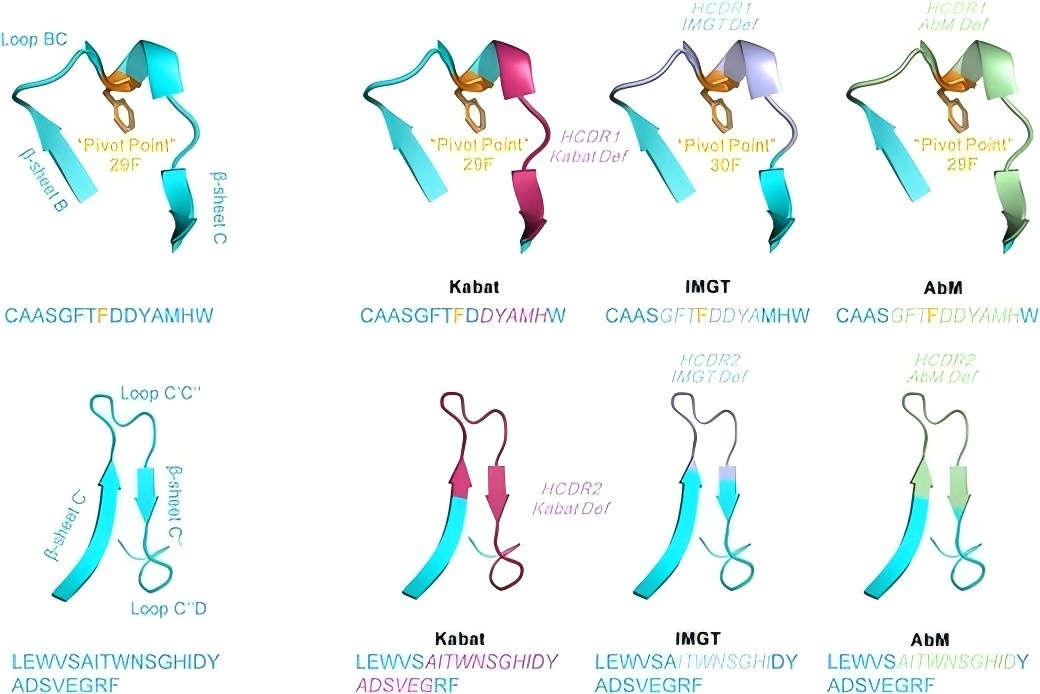 Fig. 1 The structural alignments of the CDRs based on different numbering schemes.1
Table 1. The Evolution of Therapeutic Antibodies and the Reduction of Immunogenicity
| Antibody Type | Human Sequence Content | Immunogenicity Potential |
| Murine | ~0% | High |
| Chimeric | ~66% | Moderate |
| Humanized | >90% | Low |
| Germinalized | >95% | Very Low |
Antibody Germinalization is a sophisticated engineering process that refines humanized antibodies to be virtually indistinguishable from mature human antibodies. The core principle is to revert framework and non-critical CDR residues to their closest human germline counterparts. Human germline genes are the "raw material" from which our natural antibody repertoire is generated. Antibodies that closely resemble this germline blueprint are less likely to be perceived as foreign by the immune system. At Creative Biolabs, we have developed the proprietary GHA® Platform, a cutting-edge, in-silico and in-vitro system that elevates antibody germinalization to an art form.
Our GHA® platform is a multi-step, integrated approach that combines advanced computational modeling with extensive experimental validation. It's designed to systematically identify and replace immunogenic residues without compromising the antibody's binding affinity or stability.
Partnering with Creative Biolabs for your antibody germinalization needs provides a distinct competitive advantage in the development of your therapeutic candidates.
Your journey to a best-in-class therapeutic antibody deserves a partner with the expertise and technology to navigate the complexities of antibody engineering. Let Creative Biolabs refine your humanized antibody into a highly developable, low-immunogenicity candidate poised for clinical success.
To support your entire therapeutic antibody discovery and development pipeline, Creative Biolabs offers a comprehensive suite of related services:
Contact us today to discuss your project and discover how our expertise can accelerate your path to therapeutic success.
Q: What is the difference between antibody humanization and germinalization?
A: Humanization is the process of grafting non-human CDRs onto a human framework to reduce immunogenicity. Germinalization is a further refinement step that modifies the humanized antibody's framework and non-critical CDR residues to be as close as possible to human germline sequences, which are the precursors to mature human antibodies. This further minimizes the risk of an immune response.
Q: How do you ensure that affinity is not lost during the germinalization process?
A: Our GHA® platform uses advanced 3D structural modeling to identify and preserve key residues that are critical for maintaining the correct CDR conformation and antigen binding. We then create and screen a library of variants to empirically select the candidates that retain or even have improved affinity.
Q: What starting material do I need to provide?
A: Typically, you will need to provide the amino acid or nucleotide sequences for the variable heavy (VH) and variable light (VL) chains of your humanized or parental non-human antibody. Information about the target antigen is also highly beneficial.
All listed services and products are For Research Use Only. Do Not use in any diagnostic or therapeutic applications.








